
EGYPT - THE TOMB BUILDERS' STRIKE (PROMPTS)
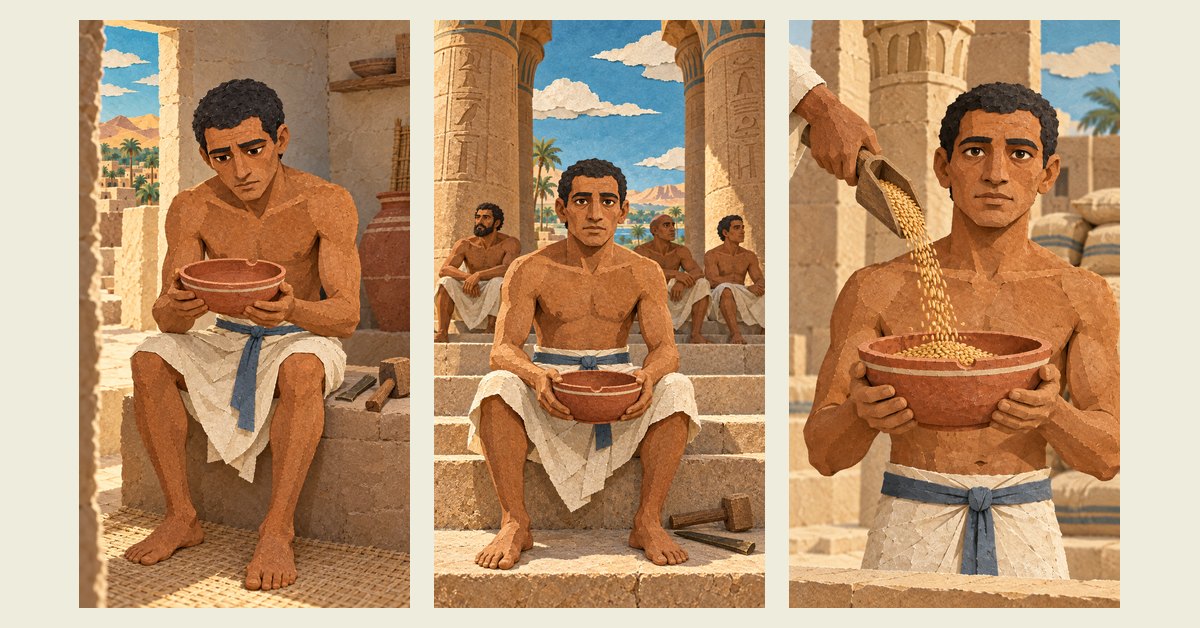
A true story in three clips. Under Ramesses III, the workers who cut the royal tombs were paid in grain. The grain stopped coming, so they stopped working. It is one of the oldest written records of a strike. The papyrus.
1. The character
Make one character sheet first. Every scene uses it, so the worker, his bowl and his tools stay the same in all three clips. Any GPT Image 2 tool, size 3:2.
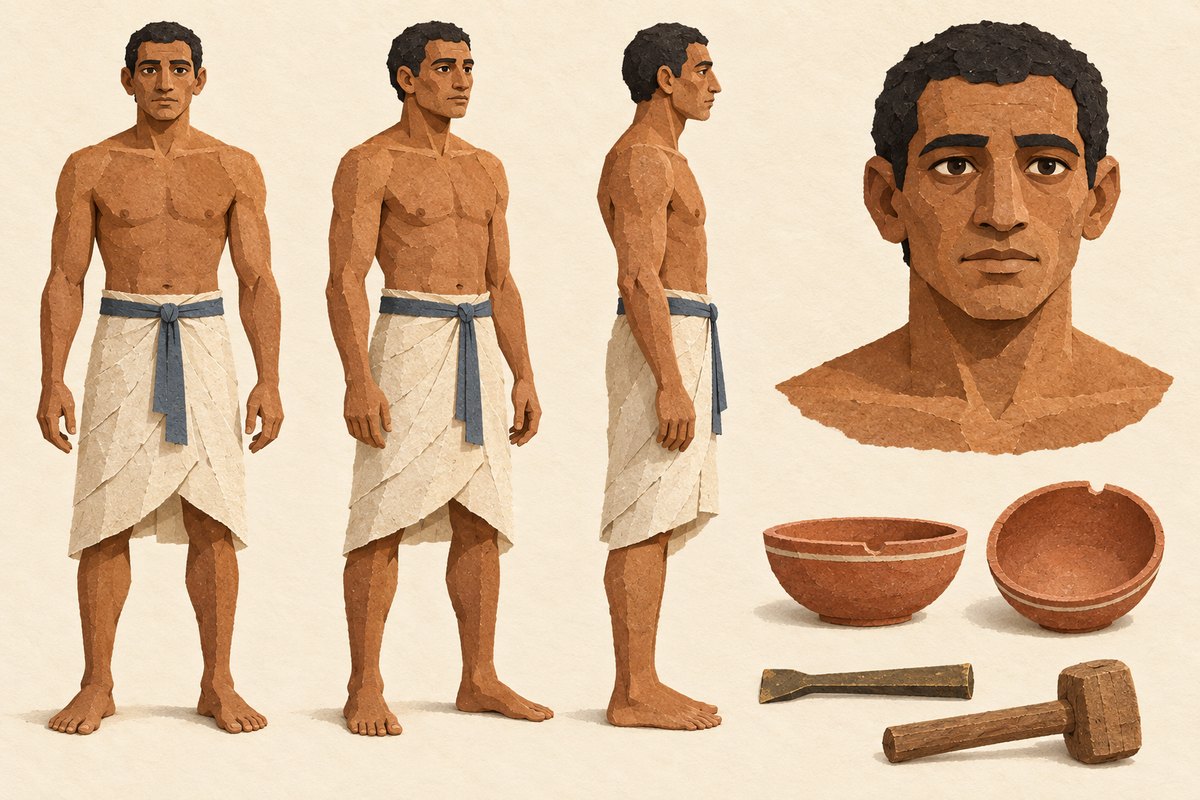
Straight-on character reference sheet on plain warm cream paper. Match the attached image's layered cut-paper craft, torn fibrous edges, sculpted paper folds, shallow cast shadows and restrained sand, cream, slate-blue palette. Show the SAME adult Egyptian tomb craftsman in three clearly separated full-body views: front, three-quarter, and side, plus one larger face study. He is about 35, warm brown skin, short close-cut black hair, clean-shaven, strong nose, tired but dignified eyes; natural adult proportions. Bare chest, undyed linen knee-length kilt, narrow muted slate-blue cloth belt, bare feet. At bottom show his shallow terracotta grain bowl in two angles, a thin cream stripe around its rim, one small notch in the rim; beside it a simple bronze chisel and plain wooden mallet. Soft warm light from upper left. Readable hands, simple layered-paper facial features, matte tactile materials. Reference supplies material and palette only; invent this ordinary worker, with no pharaoh, jewelry, headdress, pyramids, text, labels, borders, logos or watermarks. Every view must preserve face, hair, costume and bowl design. Separate figures and props with generous cream space. This is a model sheet, not a narrative scene.
2. The three scenes
Stills: GPT Image 2, size 9:16. Attach the character sheet as reference 1 and any paper-cut picture as reference 2.
Motion: Google Omni Flash 1.1 (Google Flow or the Gemini API), 9:16, 10 seconds. The still is the start frame. Scene 1 also takes the character sheet as a second reference.
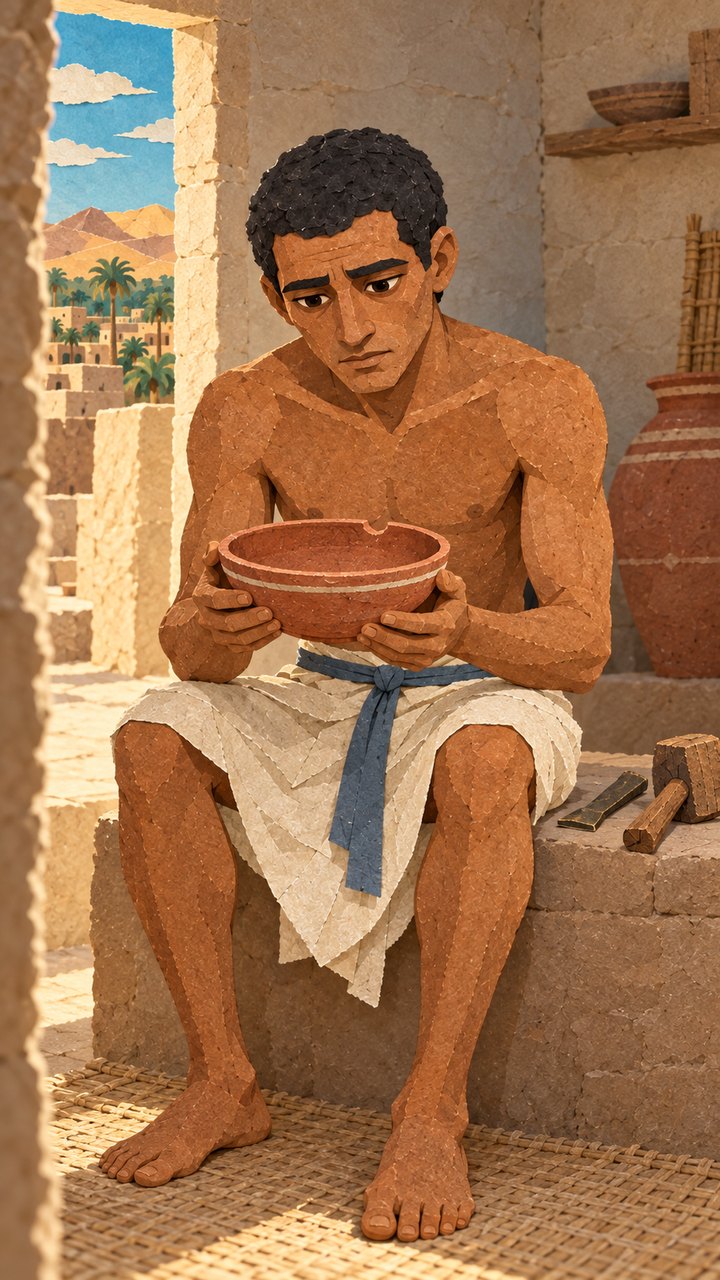
Scene 1: Empty bowl
"Ancient Egypt's royal tomb builders were paid in grain. When deliveries stopped, they went hungry."
The still
Vertical medium shot from slightly above a seated man's eye level, intimate 50mm perspective. Reference image 1 locks worker identity, costume, bowl and tools; reference image 2 supplies layered cut-paper material and palette only. The same Egyptian tomb worker sits on a low mudbrick bench in his modest home at Deir el-Medina. He holds his EMPTY shallow terracotta bowl in both hands below his face and looks into it, tired and concerned. Preserve short black hair, clean-shaven face, bare chest, undyed linen kilt, slate-blue belt and the bowl's thin cream rim stripe and notch. His bronze chisel and wooden mallet rest separately on the bench beside him. Warm daylight enters a tall doorway at upper left; soft cool shade fills the room. Foreground: soft torn-paper door edge at far left. Middle: large readable worker, face and bowl in central two-thirds. Background: sparse cream mudbrick wall, clay storage jar and doorway showing distant ochre hills. Compose for a tall phone frame, worker filling most of its height, generous space around both hands. Sand, cream, slate blue, muted terracotta. All surfaces and skin are matte layered paper with visible fibers and shallow shadows, matching references. One continuous scene; no panels, text, logos, pyramids, royal regalia, modern objects or photoreal skin.
The motion
CAMERA - ONE STATIC SHOT, NO CUTS
Locked-off camera, no zoom, no pan, no parallax. Camera position, angle, focal length and framing stay identical for all ten seconds. Doorway edges, shelves, floor and background remain in exactly the same positions on screen. Only the worker and bowl move. Keep both feet, both hands, the entire bowl and the tools visible.

REFERENCES
Image 1 is the initial frame and fixes the composition and starting pose. Image 2 is the general character-and-props sheet for the same single worker. The references are the source of truth for the art design throughout. Animate the scene from image 1; the sheet's views all represent that one worker.

ACTION AND TIMING
Clear, readable character movement with a definite start and finish to each gesture. Each action starts and finishes before the next. His torso stays quiet while his arms move; his eyes lead his head turn.

[00:00-00:01.6] Starting from the exact reference pose, he lowers the empty bowl directly DOWN to his lap using both hands together. The bowl stays upright and below his chest throughout. His elbows bend naturally and stop when the bowl rests against his thighs. His head stays above the bowl, looking down with his eyes.
[00:01.6-00:03.2] With the bowl resting in his lap, his shoulders drop once in disappointment. His eyes then shift toward the mallet and chisel on screen right. Both hands remain wrapped around the bowl.
[00:03.2-00:05.2] His head makes a deliberate, clearly visible turn toward those tools, following his eyes. His upper chest turns slightly after his head. He straightens his back a little and settles into quiet resolve. Feet remain planted in the same places.
[00:05.2-00:07.5] He keeps looking at the tools, bowl resting on his lap. One brief blink. Maintain the final pose without swaying.
[00:07.5-00:10] Continue the same settled pose. Mouth closed. The room, tools and lighting remain unchanged.

AUDIO
Quiet room tone only. No dialogue, no narration, no music. His lips remain closed.

AVOID
Raising the bowl toward his face, sniffing, drinking, reaching for tools, continuous head bobbing or body sway, sliding feet, morphing, style changes, camera shake, camera movement, cuts, text or watermarks.
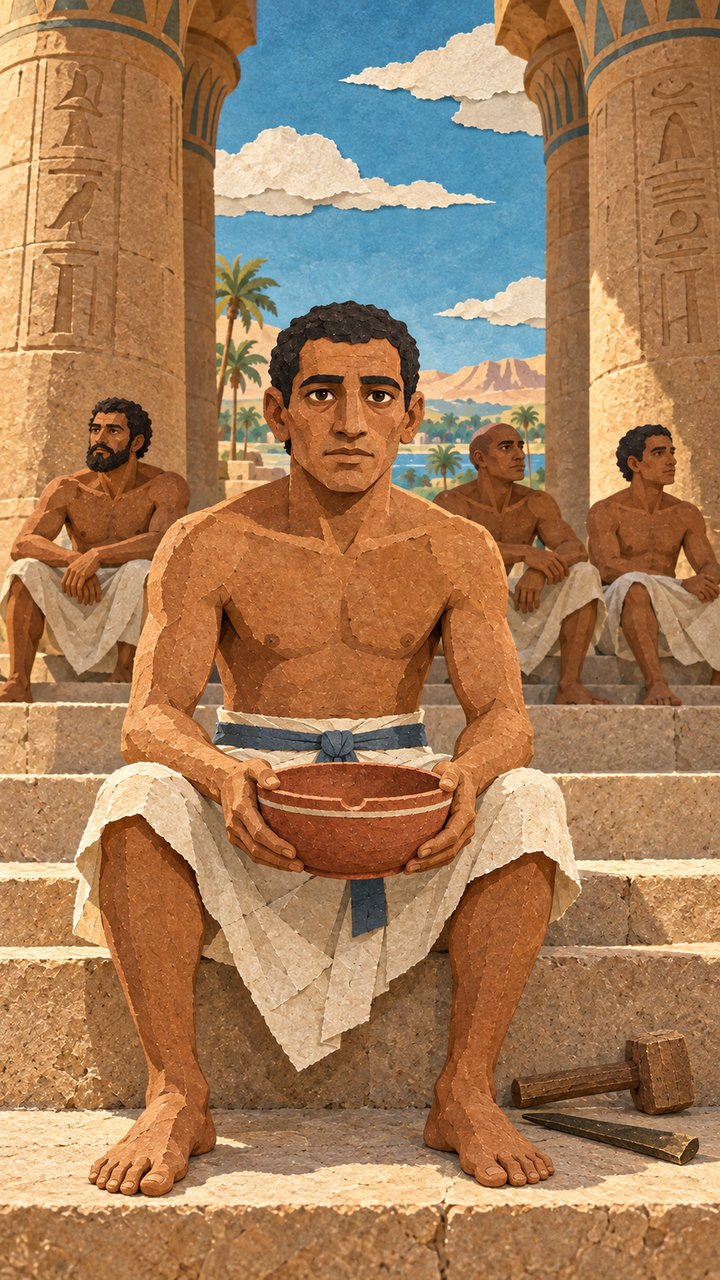
Scene 2: Tools down
"So they put down their tools and gathered at the temples. They demanded the grain they were owed."
The still
Vertical low eye-level medium-wide shot of a seated worker, restrained 40mm perspective. Reference image 1 locks worker identity, costume, bowl and tools; reference image 2 supplies cut-paper material and palette only. The SAME Egyptian tomb worker sits firmly on the lowest broad sandstone temple step near Thebes. He holds his EMPTY terracotta bowl visibly in his lap, both hands clear, looking forward with calm resolve. Preserve face, short black hair, bare chest, undyed linen kilt, slate-blue belt and cream-striped notched bowl. His bronze chisel and wooden mallet lie on the step at his side. Three other adult workers sit several steps behind him with distinct faces and plain linen clothing, quiet and resolute. Two massive sandstone columns extend upward, creating vertical scale; broad quiet sky between them. Warm daylight from upper left and cool slate-blue shade beneath the portico. Foreground: one broad sandstone step edge. Middle: hero large, face and bowl central and unobstructed. Background: seated workers and columns, subordinate and clearly separated. Faces remain readable on a phone. Sand, cream, slate blue and terracotta; tactile fibrous cut-paper edges, layered cardboard depth, subtle cast shadows. One coherent ancient Egyptian scene, no crowds, raised weapons, pharaoh, pyramids, coins, protest signs, text, logos or modern objects.
The motion
CAMERA: One continuous frontal seated eye-level shot, starting exactly from the attached temple image. The camera moves forward almost imperceptibly. Keep the worker, both hands, the whole bowl, the three men behind him and the idle tools in frame. No cuts.

STYLE AND REFERENCE: The attached image fixes every face, position, costume, prop and temple column. Preserve matte cut-paper fibers, torn edges and shallow paper shadows throughout. The central worker wears the same cream linen kilt and slate-blue belt. His empty terracotta bowl keeps its cream rim stripe and small notch. Warm daylight comes from upper left and stays constant.

TIMELINE, 10 seconds:
[00:00-00:01.5] The four workers remain seated where they are. The central worker looks ahead with quiet determination. Everyone keeps their mouth closed.
[00:01.5-00:04.5] Still the same unbroken shot. The central worker slowly raises his empty bowl a few centimetres, using both hands together, as a calm demand for food. His arms do not extend or swing.
[00:04.5-00:07] Hold the raised bowl steady. One background worker makes a small head turn toward the same unseen person ahead. The other men remain seated. The tools remain untouched.
[00:07-00:10] Living hold with tiny breaths and natural blinking. Preserve the same composition and settled positions. End gently.

AUDIO: Faint outdoor air only. No dialogue, no narration, no music.

AVOID: Chanting, waving, fists, standing, walking, crowds multiplying, extra fingers, a changing bowl, food appearing, costume changes, morphing, smooth plastic, camera shake, sudden zooms, text, logos and watermarks.
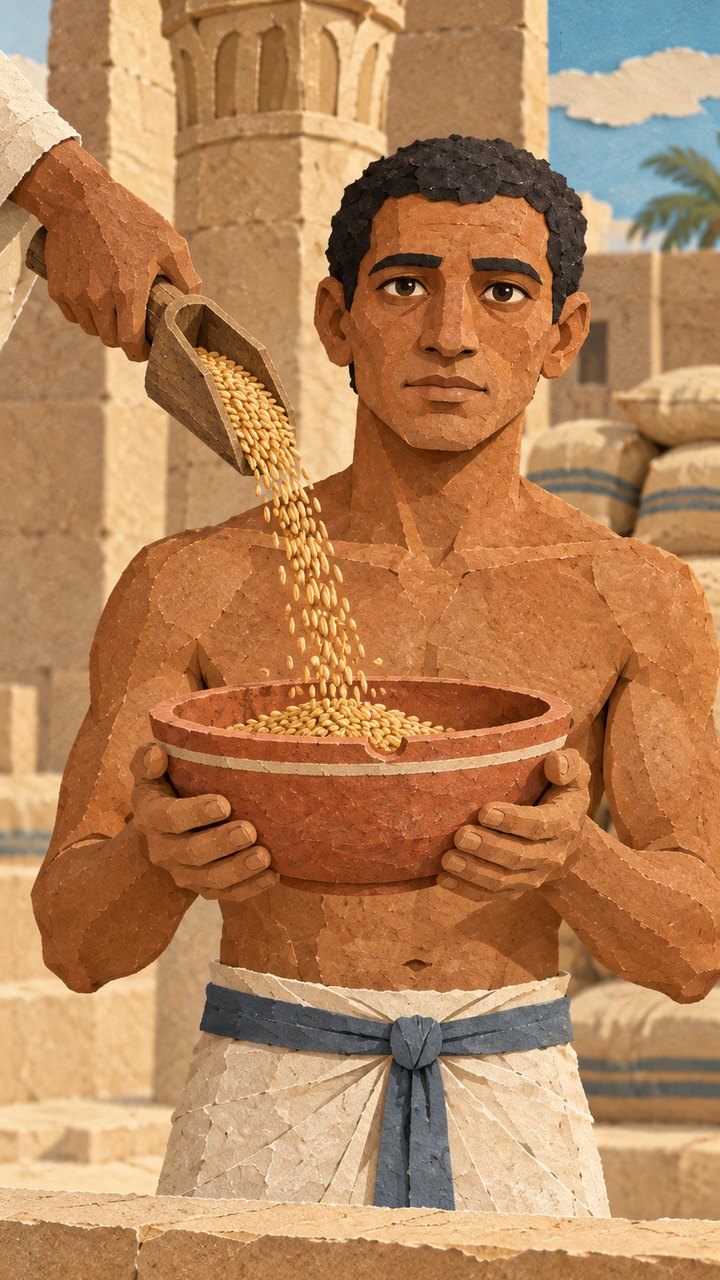
Scene 3: Grain arrives
"Officials delivered the grain. Their protest survives in one of history's earliest written records of a strike."
The still
Vertical intimate medium close-up at chest height, 65mm perspective. Reference image 1 locks worker identity, costume and bowl; reference image 2 supplies cut-paper material and palette only. The SAME Egyptian tomb worker stands in the sandstone temple courtyard, holding his familiar shallow terracotta bowl with BOTH hands just below his chest. His clean-shaven face and short black hair remain fully visible above it; quiet relief, not a grin. From upper left, only an attendant's forearm and small wooden grain scoop enter, angled to release a narrow, clear stream of golden grain into his bowl, which has a thin cream rim stripe and small notch. A modest layer of grain collects inside without overflowing. Preserve warm brown skin, bare chest, linen kilt and slate-blue belt near lower frame. The bowl and grain are central, large and readable, hands distinct with space around them. Warm daylight from upper left, cool shaded sandstone behind. Foreground: narrow soft paper ledge at bottom; middle: worker, hands, bowl, grain; background: one softly simplified sandstone column and an orderly stack of linen grain sacks. Use sand, cream, slate blue and muted terracotta. Tactile cut-paper collage with fibrous torn edges, layered paper faces and soft shallow shadows. One scene, no panels, captions, lettering, logos, coins, royalty, pyramids, photoreal skin or modern objects.
The motion
CAMERA: One continuous frontal medium close shot, starting exactly from the attached grain image. An almost imperceptible slow push forward. Keep the worker's face, both hands, the whole bowl and the pouring scoop visible. No cuts.

STYLE AND REFERENCE: Preserve the exact paper worker, face, cream linen kilt, slate-blue belt and terracotta bowl from the attached image. Keep the bowl's cream rim stripe and small notch. Preserve the existing official's cropped hand and linen sleeve at upper left. Matte layered paper, torn edges, visible fibers and shallow shadows remain throughout. Warm sunlight from upper left stays constant.

TIMELINE, 10 seconds:
[00:00-00:02.5] Continue the grain already falling from the existing wooden scoop. The stream falls downward into the bowl. Grains accumulate in a modest mound; they never float upward or turn into liquid. The worker holds the bowl steady.
[00:02.5-00:04.5] The scoop finishes emptying. The stream becomes thinner and stops. The cropped hand lifts the scoop slightly back toward the upper-left edge. The worker looks down at the grain and his tense brow softens.
[00:04.5-00:07] His shoulders release slightly. Only the smallest trace of relief reaches his eyes and mouth. Keep his lips closed and both hands fixed around the bowl.
[00:07-00:10] Living hold: one gentle breath and a slow blink. The grain remains in the bowl and no more falls. Hold this quiet resolution and end gently.

AUDIO: Soft dry grains falling into pottery, then quiet outdoor air. No dialogue, no narration, no music.

AVOID: An endless grain stream, overflowing grain, floating grains, liquid, changing bowl shape, moving fingers through pottery, extra hands, full new people, exaggerated smiles, talking, morphing, glossy surfaces, camera shake, sudden zooms, text, logos and watermarks.
3. The voice
ElevenLabs, a calm British storyteller voice. One line per scene. Cut the long pauses after.
Ancient Egypt's royal tomb builders were paid in grain. When deliveries stopped, they went hungry.

So they put down their tools and gathered at the temples. They demanded the grain they were owed.

Officials delivered the grain. Their protest survives in one of history's earliest written records of a strike.
4. Put it together
- Trim each 10 s clip to its narration line (about 5 to 6 seconds each). Hard cuts, 9:16.
- Narration on top, no music. The whole reel is about 17 seconds.
- End with the call to action on a black rounded label at the bottom. We build it in code; any editor does the same.